Sunday, 14 August 2011

Saskatoons, Saskatoons, Every Which Way


I have been living, breathing, eating saskatoons every which way since I've come back. I think it has been another form of therapy. Picking, cleaning and preserving 133 jars of those unique Northern berries kept my mind and hands so busy I could fall thankfully into bed each night and dream of sweet, purple-hued berries hovering just out of my grasp.

Trying to explain their flavour to anyone who's never tasted them is difficult and elusive. They're sweet, dense, rich, seedy, slightly blueberryish, more almondish, a bit apple-y, dusky and deep. Oh, I don't know . . . you'll just have to try them yourself, if you can get your hands on them.


 We used to pick them in the wild as children - pails and pails full of them. Always with an accompanying thrill of slight danger as mom pointed out the seedy piles of saskatoon-tinted bear poop or the large, flattened-grass, nesty areas where a berry-feasting bear had stopped to take a nap. Saskatoon berrying has always been joined in my memory with summer heat, sticky juice-stained fingers, and the grand silence of the prairie sky.

Nothing says summer more.

Now I have my own bushes and don't have to fight the bears for the tasty berries anymore (just my husband and children! And dog - Pippa loves them, too.)


This year I played around with different ways to preserve that purple summer in jars - juice, jelly, syrup, canning them with lemon, preserving them with peaches, and variations of a chutney (which recipe I'm still working on, maybe it'll be perfected next saskatoon season).

From left to right: sask-peach preserve, canned saskatoons, sask-rhubarb juice, sask-raspberry juice, saskatoon chutney, saskatoon syrup, saskatoon jelly

 Saskatoons aren't very acidic, so I find they work best with some added punch from a tangy flavour-booster. Wow, then they shine! I combined them with rhubarb or raspberries and made them into juice with my steam juicer. Refreshing, and with that deep purple colour, I figure they've got to be high in antioxidants. Bonus.


 Saskatoon-Peach Preserve

If you can't get saskatoons, this might work with blueberries, though I imagine it would be a bit more liquidy since blueberries are much more juicy than saskatoons, so you may need to cook it a bit longer to reduce the juices to the right consistency. The orange flower water lends a subtle, complex flavour that I love, however if you can't find any, this preserve is delicious without it, too. Orange flower water and rose water are available at ethnic markets.

5 pounds (2.25 kg) saskatoon berries, picked over, rinsed and drained
12 peaches (about 5 pounds or 2.25 kg)
juice of 2 lemons
1 cup (250ml) honey
2 tsp orange flower water (or rose water - they both taste great, just subtly different)

Dip the peaches in boiling water for 1 to 2 minutes, until the skins loosen. Put into a bowl of cold water to cool, then slip them out of their skins. Cut them into wedges, then slice each wedge into about 4 pieces.

Place the saskatoons, diced peaches and lemon juice into a large heavy-bottomed stock pot. Bring to a boil, stirring occasionally, then turn down the heat to low and add the honey. Simmer the fruit mixture, stirring often, about 15 to 30 minutes, until the desired thickness is reached. You want it to be saucy, not jammy, and the berries still relatively whole, although the peach chunks should be nicely softened and starting to break apart.

 Ladle the hot mixture into hot, sterilized jars and seal with hot sterilized lids. (You may process them in a boiling water bath for added insurance against spoilage.) Leave jars on counter to cool.
Alternatively, you can let the mixture cool and ladle it into containers, then freeze it for future use.

Delicious served chilled as a fruit dessert, or over ice-cream, yogurt, pancakes, cheesecake, rice pudding . . . use your imagination.


Canned Saskatoons

For years, growing up, I ate canned saskatoons as a fruit dessert, but I always found the flavour a little bland. This year I experimented with adding lemon, and ba-da-bing, ba-da-boom! The missing link! They now have zing, and my kids can't get enough of them. (It is important to use organic lemons here, as you are using them peel and all, and you don't want to preserve all those toxic chemicals right into the jars.)

saskatoons, picked over, rinsed and drained
organic lemons, sliced
honey
water

Make a simple syrup with the ratio of 1 cup honey to 4 cups water. Bring to a boil and keep hot, You will need about 1 to 1-1/2 cups syrup for each quart of berries. (Save any leftover syrup in the fridge and use it to sweeten summer drinks.)

Into each sterilized quart jar put 2 slices of lemon - lay 1 slice on the bottom of the jar and cover with a handful of saskatoons, then tilt the jar slightly and lay another slice against the side of the jar and fill it to within 3/4 inch of the top with berries, making sure the lemon stays against the outside of the jar. But don't overstress about this - it just looks prettier if you can see the lemon slice from the outside of the jar. If using pints, you only need 1 slice of lemon per jar - put it against the outside of the jar.

Pour over the hot honey syrup to within 1/2 inch of the top of the jars. Close the jars and process in a boiling water bath for 20 minutes (15 minutes for pints).

(Don't tell anyone the lemon slice is the best part, or you'll have to fight them for it!)


Wednesday, 10 August 2011

Naure's Gifts: Fresh Trout, Morels and a side of Bannock

What gifts nature has to offer, if we only stop to look - or listen - or thread a hook.

I've just come back from a week at my parents' cabin in northern British Columbia, on the shores of the shockingly cold and pristinely clear Francois Lake. It was a time to regroup with family and reconnect with nature. To have lovely saunas and run squealing into the lake. To pick teeny-tiny wild strawberries. To throw sticks for the dogs and build campfires. To swat mosquitoes and clean up sheds.

And of course to eat.

Every meal was a feast and some were more feasty than others. But the best ones were those using nature's gifts.

Between my sisters and I we had six children at the cabin between the ages of 12 and 15, so we had a constant supply of willing fishermen to head out in the canoe and sturdy old fishing boat. They came back proudly with their daily catch of fresh rainbow trout and even a few elusive Arctic Char.


Those we rolled in cornmeal and pan-fried, sometimes only moments after they'd been pulled from the sparkling waters. A fried taste of heaven.


Other days we were lucky enough to feast on campfire-roasted venison. Provided by my sister and husband, cut into rough chunks, marinated in wine and spices, then speared onto sharpened willow sticks and roasted to perfection over glowing campfire coals - crisp and browned on the outside, pink and meltingly tender on the inside.


Followed by a toasty spiral of bannock roasted on those same sticks and filled with drippy, oozing maple syrup to lick off fingers and lips.


But Nature outdid herself when she offered up for us to share -  her abundant crop of wild forest morel mushrooms. These were thanks to the devastating forest fires that spread through this area last year. Every cloud has a silver lining, and we were really thankful for these. They grow best in burned out areas, so we reaped the benefits this year. A whole pailful of these funny, wrinkly-looking little forest caps. Tasting of the earth and the woods.

Slathered with just enough of a cream cheese and white wine sauce to enhance but not overpower their delicate flavour.


And served over wonderfully dense and chewy biscuit/pancakes made from the leftover bannock dough patiently fried by Hannah, my 12 year old niece.


Another kind of heaven.


Morels in Wine Sauce

This is more a method than a real recipe. It all depends on how many mushrooms you can get your hands on, and what type they are and the mood you're in (I imagine any other variety of mushrooms will do, too. They just won't have quite the same earthy richness) and how big your scoops of cream cheese and your glug of wine are. Proportions aren't really all that important. It tastes good whichever way it turns out - saucier or stewier.


fresh morel mushrooms - enough to feed your crowd (I had about 8 to 10 cups chopped)
1 or 2 large onions - use 2 if you have over 6 - 8 cups of chopped mushrooms
1 Tablespoon butter
2 Large spoonfuls of cream cheese (about 1/4 to 1/2 cup each)
1 large glug of white wine
salt and pepper to taste

Chop the onions.

Melt the butter in a large high-sided skillet over medium heat. Add the onions and saute until translucent.

Meanwhile chop the morels (or other mushrooms) into bite-sized chunks. Leave small ones whole. (Don't wash the mushrooms, just wipe off any bits of forest still stuck to them.)

Add the mushrooms to the onions and saute, stirring occasionally, until the mushrooms have released all of their juices,about 10 minutes. If they are fresh you will have quite a bit of flavourful mushroom liquid.

Dig two large spoonfuls of creamcheese out of your container and glop them into the mushroom mixture. If you have a block of creamcheese, cut off 2 corresponding-sized chunks.

Stir gently until the creamcheese has melted, then pour in a generous glug of white wine.

Season to taste with salt and pepper and let simmer a few more minutes until the consistency of the sauce is to your liking.

Serve over the bannock recipe that follows, or over rice, or pasta, or even toast. Or just eat it from the pan with a spoon and smack your lips often. Wash down with the rest of the white wine (well at least share the bottle with someone else).


Bannock

We always make a big batch of this dough when we are at the cabin. We pinch off a bun-sized piece and roll it between our hands to make a long rope, then spiral it around clean de-barked sticks and roast it slowly over the fire. Nice hot coals work the best. And be patient. They take a while to roast, but when you are in good company, what does time matter?

When done, pull the baked bannock carefully off the stick, drizzle the inside with maple syrup or jam, and lick greedily off your fingers while you devour the whole thing. I dare you to wait long enough to let it cool so you don't burn your mouth.

Another way to do them, is to roast a sausage til crackling and bursting with juices, then wrap it with the spiral of bannock dough and roast it again til the dough is golden brown and puffy. A perfect campfire pig-in-a-blanket, well worth the wait.

3 cups flour
3 Tbsp baking powder
1 tsp salt
2 Tbsp melted butter
1  1/2 cups water

Mix dry ingredients in a large bowl. Make a well in the center and pour in the melted butter and the water.
Mix with a spoon until that doesn't work any more, then go in with your hands and work the mixture into a ball. Turn it out onto a lightly-floured surface and knead it until it makes a nice elastic ball. This is different from normal biscuit dough, which needs a very light touch. You don't have to worry about overworking the dough. What you're after is actually a dense and chewy dough.

It is now ready to roast over the fire, or roll it into egg-sized balls, pull them flat to make little pancakes and fry them in a mixture of butter and oil in a preheated heavy pan. When they are golden brown on each side, they are ready to serve topped with the morel mushroom sauce. Or you can just sprinkle them with sugar and eat them standing at the stove. Or do both.

This dough keeps, covered, in the fridge for 3 to 4 days, so make a large batch and it's always ready for your gourmet camping cravings.


Wednesday, 27 July 2011

Monster Rhubarb and Two Cordials

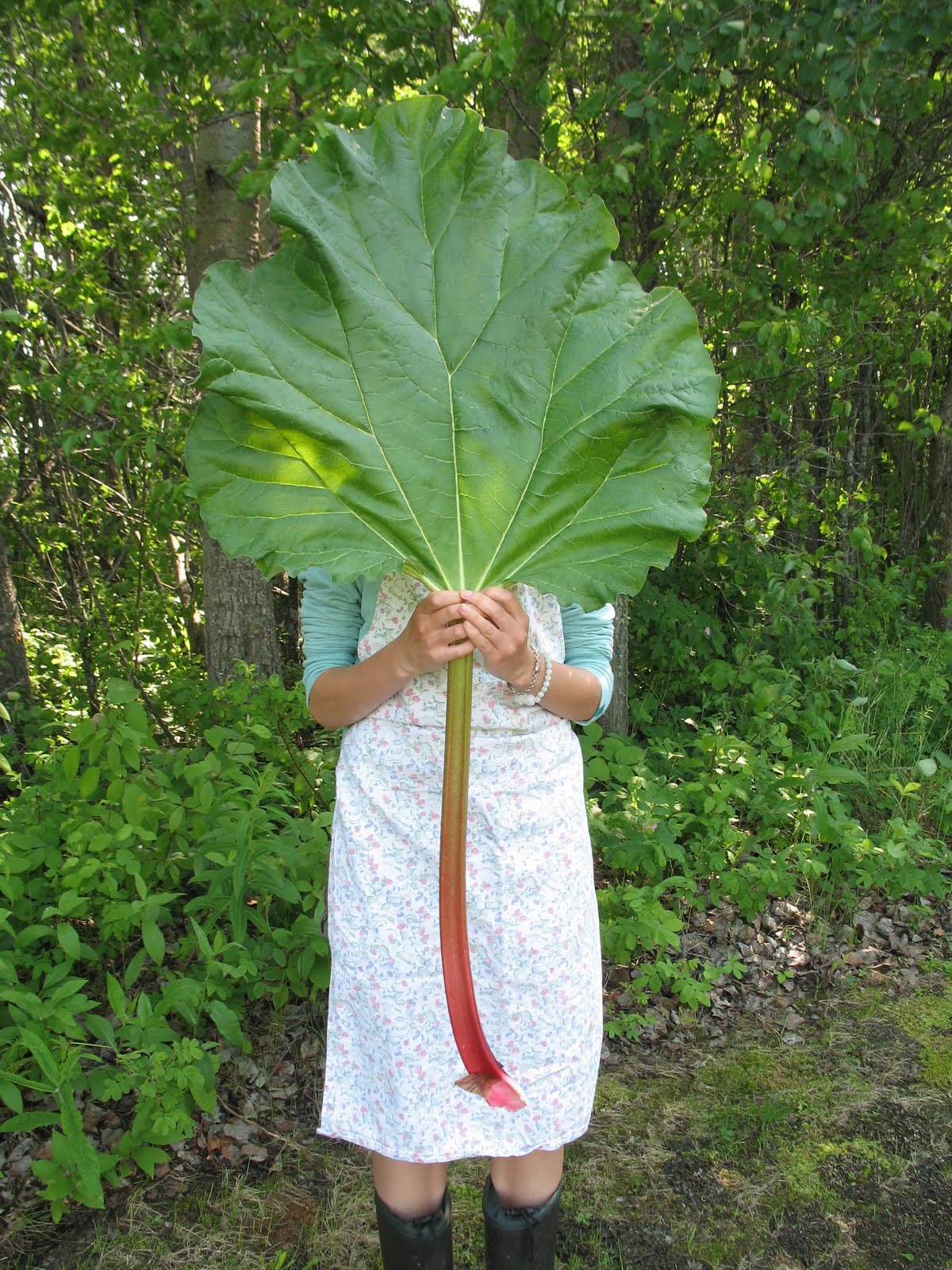
My rhubarb is on steroids.

Seriously.

It is monstrously huge.

This is our full-grown Labrador Retriever, Pippa, guarding the giant rhubarb.

 I'm not sure what variety it is. It came from a piece of root my mom got, who got it from a friend, who got it from her neighbour's second cousin, who got it from her.....you get the picture.

It has produced copious, extra large, non-woody stalks for years. It produces well all spring and summer, as long as I keep removing the taller-than-I-am seed stalks (though it is a shame because they are so showy and kind of outer-spacey looking). This year has been very wet and cool, so the rhubarb is not even at its usual prime. Some years the stalks are as thick as my wrist.

Here they are in comparison with my normal sized, regular rhubarb plant stalks.


I have been making juice lately, and cake, and stewed rhubarb, and roasted rhubarb.
A particular favourite has been my rhubarb-ade with lavender blossoms and rosewater. Mmmmm - a lovely sparkly cocktail (with maybe a touch of vodka), or a refreshing summer juice, or a light and slightly floral thirst-quencher when I add a splash of it to flavour my drinking water.


Regular rhubarb on left

Rose and Lavender Rhubarb Cordial

2.5 lbs (1.15 kg) rhubarb, cut in 3 to 4 inch pieces (about 10 cups if cut in 1/2 inch pieces)
4 cups (1 litre) water
1 Tbsp (15 ml) edible, dried lavender flowers
1 1/2 tsp (7.5 ml) rosewater
3/4 cup (175 ml) honey or agave nectar, or 1 1/2 cups (350ml) sugar

Combine rhubarb, water and lavender flowers in a large pot.
Bring to a boil, then turn heat to low. Cover and simmer for 15 minutes or until rhubarb is completely softened and easily separates into strings.

Line a strainer with a double layer of cheesecloth or a clean and rinsed tea-towel and set it over a bowl. Pour the rhubarb mixture into it and let strain until no more juice drips out ( 1/2 hour or longer). Or you can strain the mixture in a jelly bag hung over a bowl.
While still warm, stir in the rosewater and honey, agave or sugar. Stir to dissolve. (Reheat lightly if the cordial has cooled too much to dissolve the sweetener.)
Let cool and funnel into a pretty container. An empty wine bottle works well.

This recipe makes 2 wine bottles of cordial - or about 6 cups (1.5 litres)
(One bottle to keep and one to give away.)

To dilute the cordial for serving, play around with the taste ratios you prefer. I like to mix about equal amounts of cordial with sparkling water over ice to make a drink cocktail, or 1 part cordial to two or three parts chilled tap water to make a summer rhubarb-ade (either in a pitcher or glass), or a small splash into a tall glass of ice-water for a light flavoured-water refresher.


Bay and Star Anise Rhubarb Cordial

(Bay and anise shown for a double batch)
Follow the proportions in the recipe above for Rose and Lavender Cordial, except substitute 2 large bay leaves and 3 star anise pods for the lavender flowers, and omit the rosewater when you add the sweetener.


Rhubarb is a spring and summer staple in our house - good for many uses, maybe even a game of hide-and-seek.


Saturday, 16 July 2011

Healing Hands


 Two weeks ago my dad died.

It has been very hard.

My heart has a hole in it that has no edges. The hole just ebbs and flows like the tide.


But healing has been happening, and it has been happening with the connection and love that comes from sharing such a shattering time with loved ones who are going through it with you. And it happens with the sharing of memories, and hugs, and tears, and the daily chores that must go on.


It comes with the healing power of hands: hands that hug, hands that wipe away tears, hands that clasp, hands that gently pat, hands that clap, hands that chop and slice and wipe and serve.

And much of that healing happens in the kitchen - at least in our family it does. And food is always part of it.


In the loving act of preparing nourishment for the swarm of aching hearts and bodies streaming through the house in the past few weeks, many hands were busy.


I remember my dad's hands and wish I could hold them again.